In the fast-growing financial landscape of the Philippines, online lending apps (OLAs) have become a go-to solution for many Filipinos facing urgent cash needs. You’ve likely seen advertisements promising “low monthly interest rates” of only 1% or 3%. At first glance, this sounds like a bargain. However, many borrowers find themselves shocked when their actual repayment amount is much higher than expected.
The secret lies in a term often hidden in the fine print: Effective Interest Rate (EIR). If you want to avoid the “debt trap” and manage your finances responsibly, understanding why the monthly rate is NOT your total cost is the most important step you can take.
The Marketing Trap: Monthly Rate vs. Reality
Most lending apps in the Philippines promote their Nominal Interest Rate. This is the “face value” interest rate—the one that looks good on a marketing banner.
For example, an app might advertise: “Borrow 10,000 PHP at only 2% per month!”
To a casual borrower, the math seems simple: 10,000 x 0.02 = 200. You expect to pay 200 PHP in interest. However, when you receive the money, you might only get 9,000 PHP (due to upfront fees), or you might be asked to pay back 11,500 PHP after just 30 days.
This discrepancy happens because the monthly nominal rate ignores three critical factors:
-
Compounding frequency.
-
Upfront service and processing fees.
-
The timing of your repayments.
What is Effective Interest Rate (EIR)?
The Effective Interest Rate (EIR) is the “true” interest rate. It represents the actual cost of a loan over a year, accounting for the effects of compounding and all mandatory fees associated with the credit transaction.
In the Philippines, the Truth in Lending Act (Republic Act No. 3765) mandates that all creditors must disclose the full cost of credit to the borrower before the transaction is finalized. This includes the EIR.
While the monthly rate tells you how much the interest is for 30 days, the EIR tells you how much the loan is actually costing you annually when every single charge is factored in.
The “Hidden” Costs: Why the Math Doesn’t Add Up
The reason the monthly rate is misleading is that it doesn’t include “Other Charges.” In the Philippine OLA industry, những loại phí này rất phổ biến:
A. Processing and Service Fees
Many apps deduct a “service fee” before the money even touches your bank account. If you borrow 5,000 PHP but the app deducts a 500 PHP service fee, you only receive 4,500 PHP. However, the interest is still calculated on the full 5,000 PHP. This significantly spikes the EIR.
B. Verification and Administrative Fees
Some lenders charge for “credit investigation” or “system maintenance.” These are often one-time fees but, for short-term loans (like 7 or 14 days), they represent a massive percentage of the loan amount.
C. The “Add-on” Interest Fallacy
Many borrowers assume interest is calculated on the declining balance (the amount you still owe as you pay it off). However, many OLAs use “flat” or “add-on” rates, where you pay interest on the original principal for the entire duration, even if you’ve already paid back half the money.
How to Calculate the Real Cost (Simple Formula)
While banks use complex formulas, for a typical borrower, a simpler way to look at the Total Cost of Credit is using this manual check:
Total Repayment Amount – Actual Cash Received = Total Cost of Borrowing
Example:
-
You apply for: 5,000 PHP
-
Service fee deducted: 600 PHP
-
Cash you actually receive: 4,400 PHP
-
Total amount you must pay back after 14 days: 5,400 PHP
Real Cost Calculation:
5,400 (Repayment) – 4,400 (Received) = 1,000 PHP cost for 14 days.
If you look at this annually, the interest rate is staggering, often exceeding 200% per year, even if the app says it only charges “0.5% per day”.
Why the SEC Philippines Cares About EIR
The Securities and Exchange Commission (SEC) of the Philippines has issued numerous circulars (such as SEC Memorandum Circular No. 3, Series of 2022) to protect borrowers.
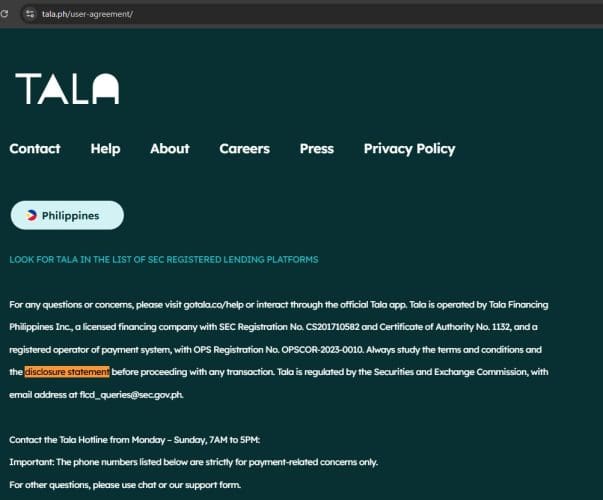
Lenders are now required to provide a Disclosure Statement that clearly shows:
-
The cash proceeds of the loan.
-
Any amount to be paid for registration, insurance, or other fees.
-
The total finance charges.
-
The Effective Interest Rate (EIR) expressed as a percentage per month and per year.
If a lending app does not show you những con số này rõ ràng before you click “Accept,” they are likely in violation of Philippine lending laws.
How to Protect Yourself: A Checklist for Borrowers
Before you sign any digital loan contract, follow these steps to ensure you aren’t being misled by “low monthly rates”:
-
Ask for the Disclosure Statement: Legitimate SEC-registered apps will always provide a summary of the loan terms. If it’s not there, don’t borrow.
-
Look for the “Net Proceeds”: Check exactly how much will be deposited into your GCash or bank account. Compare this to the “Principal Amount.”
-
Calculate the Daily Rate: If an app charges 500 PHP for a 7-day loan of 2,000 PHP, that’s 71 PHP per day. Over a year, that is over 1,000% interest!
-
Check for Late Payment Penalties: In the Philippines, some apps charge 1% to 5% per day of delay. This can turn a small loan into an unpayable debt within weeks.
-
Identify the SEC License: A low rate means nothing if the company isn’t authorized. Verify the Certificate of Authority (CA) number on the official SEC Philippines website.
Alternatives to High-EIR Loans
If you calculate the EIR of an app and find it to be excessively high (e.g., above 15% per month or 180% per year), consider these alternatives:
-
PAG-IBIG or SSS Salary Loans: These offer the lowest EIR for Filipinos, often around 10% per year.
-
Credit Unions/Cooperatives: If you are a member of a co-op, EIRs are generally capped at 1% to 2% per month on a declining balance.
-
Digital Banks: Platforms like Maya Bank, SeaBank, or CIMB often have more transparent and lower EIRs than “fast cash” OLAs.
Conclusion: Be a Smart Borrower
The “Monthly Rate” is a marketing tool; the “EIR” is a financial reality. In the Philippines, where the cost of living is rising, being “financially literate” is your best defense against predatory lending.
Always remember: A loan that looks too easy to get often comes with the highest EIR. By focusing on the total amount you will pay back versus the actual cash you receive, you can avoid the traps laid by unscrupulous lenders.
At secregisteredloanapp.com, we are committed to helping you navigate the complex world of Philippine online lending. We verify SEC registrations so you can borrow with confidence and clarity.
⚠️ Financial Disclosure
This article is for educational purposes under our Financial Knowledge category. It does not constitute legal or financial advice. Always consult with a professional advisor and verify the legal status of any lending app with the SEC Philippines (RA 3765 & RA 10173 compliance) before committing to a loan.





Leave a Reply